

Indirect auto lending remains the dominant origination channel in the U.S., with dealers originating the majority of financed vehicle purchases. For lenders, this channel delivers scale, but also places pricing accuracy, risk control, and compliance execution at the point of sale.
This article examines the key indirect auto lending trends in 2026, including shifts in dealer behavior, pricing discipline, risk segmentation, and execution standards that lenders must manage to remain competitive at scale.
| Indirect Auto Lending Trends: At a Glance | ||
| Trend | Opportunity Created | How Leading Lenders Are Responding |
| Dealer-Centered Origination Still Dominates, but Lender Mix Is Shifting | Dealers have more lender choice and flexibility | Compete with faster approvals and adaptable pricing |
| Credit Tightening Is Selective Within Indirect Channels | Precision risk control preserves volume | Apply deal- and dealer-level segmentation |
| Dealer Expectations Are Shifting From Rate-First to Execution-First | Execution quality drives repeat placement | Deliver speed, certainty, and clean funding |
| Indirect Lending Compliance Is Moving Upstream Into Origination | Early controls reduce downstream risk | Embed compliance directly into origination workflows |
Trend 1: Dealer-Centered Origination Still Dominates, but Lender Mix Is Shifting
Dealer-originated auto lending continues to expand in both volume and outstanding balances, reinforcing the dealer channel as the primary engine of auto finance growth. At the same time, the composition of lenders competing for that volume is changing.
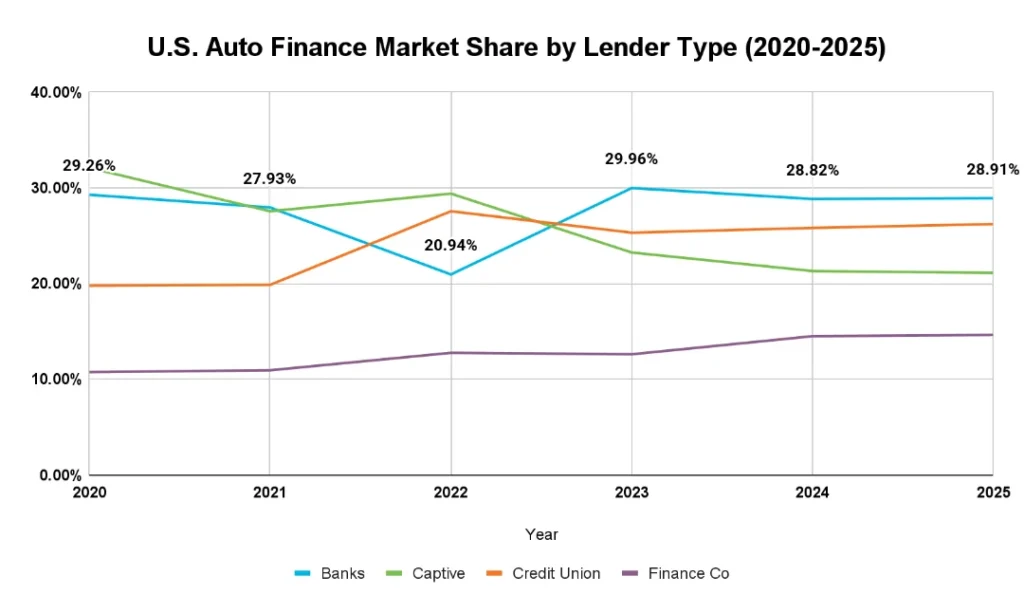
Banks, credit unions, and non-captive lenders are capturing a larger share of dealer-originated loans as credit availability improves and captives relinquish some market share, reshaping competitive dynamics at the point of sale.
What the data shows:
- Dealer finance remains a key segment: Equifax’s Auto Insights Report shows that dealer finance lenders continue to grow originations and outstanding balances, with dealer finance debt up over 20% year-over-year, even though the absolute dollar share remains smaller than banks or captives for total debt.
- Banks and non-captive lenders are gaining share: According to Experian’s State of the Automotive Finance Market Report, banks increased their overall auto finance market share to 28.9%, credit unions modestly grew, while captive lender share declined, indicating indirect channel power is spreading across lender types.
- Credit access is loosening through dealer channels: According to the Dealertrack Credit Availability Index, auto credit access continued to improve through 2025, with higher approval rates, such as a ~150 basis point rise in March 2025 and a 73.6% auto loan approval rate recorded in November 2025, indicating broader access across dealer-originated channels, including non-captive segments.
What this means for lenders in 2026:
In 2026, lenders that win in the indirect channel will be those that execute best at the point of sale, delivering fast approvals, adaptable pricing, and consistent funding.
Institutions that rely on legacy relationships or captive advantage without matching execution speed and flexibility risk losing share as credit access broadens and dealer leverage increases.
Trend 2: Credit Tightening Is Selective Within Indirect Channels, Not Broad-Based
Credit conditions in auto lending are tightening, but not evenly across the market. In these indirect auto lending trends, where dealers originate the majority of applications, lenders are becoming more selective at the dealer, deal, and structure level, rather than pulling back uniformly across all borrowers or credit tiers.
What the data shows:
- Subprime stress is concentrated in dealer-originated loans: Subprime auto loan delinquency reached a record 6.65% at 60+ days past due in October 2025, according to Fitch Ratings data reported by Reuters. Subprime borrowers are disproportionately financed through dealers, meaning rising delinquency pressure is showing up first, and most acutely, in indirect lending portfolios.
- Approval outcomes are diverging inside the indirect channel: The Dealertrack Credit Availability Index, which measures dealer-submitted auto loan applications, shows that overall credit access improved through 2025 while approval outcomes became more variable by lender type and risk tier. This indicates selective tightening within indirect channels, not a broad contraction of dealer financing.
- Risk controls are shifting toward deal structure, not just credit score: TransUnion’s Q3 2025 Credit Industry Insights Report shows increasing polarization in credit risk, with the fastest growth in auto originations occurring at both ends of the spectrum, super prime and subprime, while middle tiers continue to thin.
What this means for lenders in 2026:
This divergence means that borrowers within similar score ranges exhibit materially different affordability and performance outcomes. In response, lenders are managing indirect risk less through broad score cutoffs and more through deal structure controls, including term length, advance rates, and payment-to-income thresholds, to better align approval decisions with payment burden and early performance risk at the point of sale.
In indirect auto lending, risk management is increasingly defined at the dealer level. Lenders that can dynamically adjust structure, pricing, and approval logic by dealer, borrower profile, and deal characteristics will remain competitive while managing loss exposure.
Those relying on blunt score-based rules or manual dealer oversight will struggle to balance volume and risk as indirect lending conditions continue to fragment.
Trend 3: Dealer Expectations Are Shifting From Rate-First to Execution-First
After years of volatility, dealers are placing more weight on the certainty of approval, speed to funding, and execution reliability when choosing lending partners. In competitive showroom environments, the lender that can deliver fast, consistent outcomes is increasingly favored over the lender offering marginal pricing advantages with friction.
What the data shows:
- Digital execution quality drives repeat usage: The 2025 U.S. Automotive Finance Digital Experience Study from J.D. Power shows that lenders with stronger digital execution, including faster processing, clearer communication, and fewer errors, see significantly higher intent to reuse lender websites and applications among auto finance users. While the study is consumer-focused, it reinforces the broader market reality that execution consistency directly affects channel loyalty and repeat engagement.
- Operational friction undermines lender competitiveness: J.D. Power findings show that gaps in speed, navigation, and system reliability reduce satisfaction and reuse, particularly for non-captive lenders that compete heavily in indirect channels. In practice, these execution gaps translate into lower dealer confidence and reduced repeat submissions over time.
- Dealer platforms reward predictability: Cox Automotive research and Dealertrack commentary consistently highlight that lenders integrated into dealer workflows must minimize rework, documentation delays, and funding uncertainty to remain competitive.
What this means for lenders in 2026:
In 2026, indirect lenders compete on execution credibility, not just credit appetite. Dealers favor lenders that deliver fast, predictable outcomes with minimal friction, especially in near-prime and used-vehicle transactions where speed and certainty matter most.
Lenders that operationalize consistency through automated decisioning, clean dealer integrations, and reliable funding workflows will earn repeat dealer volume. At the same time, those with manual exceptions and variable execution will steadily lose share regardless of pricing.
Trend 4: Indirect Lending Compliance Is Moving Upstream Into Origination
As indirect auto lending continues to command a large share of consumer financing, compliance risk is increasingly determined before funding.
Regulatory focus is shifting toward how pricing, disclosures, and execution decisions are made at origination, especially in dealer-facilitated origination models, because inconsistencies at this stage often create the violations that later trigger enforcement.
What the data shows:
- Consent orders emphasize upstream failures: In early 2025, the CFPB entered a consent order with a major auto manufacturer’s finance arm for furnishing inaccurate credit information and failing to correct it promptly, violations tied to reporting and credit information systems that originate during loan setup and data capture. The settlement included over $10 million in consumer redress and penalties, underscoring that origination and reporting errors carry significant regulatory consequences.
- CFPB supervision targets execution and reporting errors: CFPB compliance updates note that examination findings in auto lending have included inaccurate credit reporting of payment information and failure to promptly update or correct credit data mistakes that often stem from origination and servicing systems, not just downstream processes.
- State consumer protection trends raise the upstream bar: Recently, multiple states, including Colorado, Illinois, Massachusetts, and New York, moved to enhance price transparency and fee disclosure requirements under consumer-protection laws, part of a broader push toward upfront clarity that intersects with auto loan offers and dealer-facilitated originations.
What this means for lenders in 2026:
Leading lenders are shifting compliance upstream by embedding jurisdiction-aware pricing rules, disclosure controls, and data validation directly into dealer-facing origination workflows. This approach reduces execution errors before they occur, standardizes compliance across dealer networks, and allows lenders to scale indirect volume without increasing regulatory risk in proportion.
How Lenders Can Execute on Indirect Lending Trends in 2026
As indirect auto lending evolves, an advantage is created by designing origination systems that absorb volatility without breaking execution. In 2026, lenders that outperform are aligning around a small set of operational priorities that translate these trends into repeatable results.
- Automate decisions at the dealer desk: Eliminate manual intake and sequential reviews so approvals and funding happen while the buyer is still in the showroom.
- Control risk at the deal level: Adjust terms, advances, and approvals dynamically by borrower profile and structure, rather than tightening entire credit tiers.
- Differentiate dealers by performance: Prioritize speed, pricing flexibility, and volume allocation for dealers that produce clean documentation and stable early performance.
- Enforce compliance in origination systems: Apply pricing caps, disclosures, and state rules automatically before funding to prevent errors rather than correcting them later.
Indirect lenders that systematize speed, risk, and compliance win repeat dealer volume. Those that rely on manual processes lose share, regardless of rate.
Powering Scalable Indirect Lending Execution with defi SOLUTIONS
defi SOLUTIONS supports indirect auto lenders with auto-native origination technology designed to operate at dealer scale. By embedding credit rules, pricing logic, compliance controls, and workflow automation directly into dealer-facing processes, defi helps lenders compete on speed and consistency without increasing risk. Book a demo to see how defi enables faster dealer decisions, cleaner execution, and scalable indirect growth.


