

Auto loan default rates and related metrics are a window into borrower stress, portfolio health, and the effectiveness of collections strategy.
As payment pressure has risen in recent years, lenders are watching a chain reaction unfold: higher early delinquencies, increased repossession activity, and changing recovery outcomes in remarketing. Understanding how these pieces connect is essential for banks, credit unions, captives, and finance companies managing risk in 2026.
This guide brings together the latest industry data on auto loan default rates, repossession volumes, and collection performance, and explains what those trends mean for lenders making credit and servicing decisions today.
Auto Loan Default Rates Trends
Before we talk numbers, it helps to clear up an important point:
Delinquency and default are not the same thing.
In everyday conversation, people use those terms interchangeably. In auto lending, they represent very different stages of borrower distress.
Delinquency is when a borrower misses a payment or two. But when the loan is unlikely to be collected, it is typically classified as default once it is 90+ days past due.
Latest Auto Loan Default Rates
The share of U.S. auto loans that were 90+ days past due climbed from roughly 3.8% in early 2023 to about 5.17% by Q4 2025. Throughout 2024, the rate hovered in the low-4% range before rising above 4.8% by late 2024 and crossing the 5% mark in late 2025.
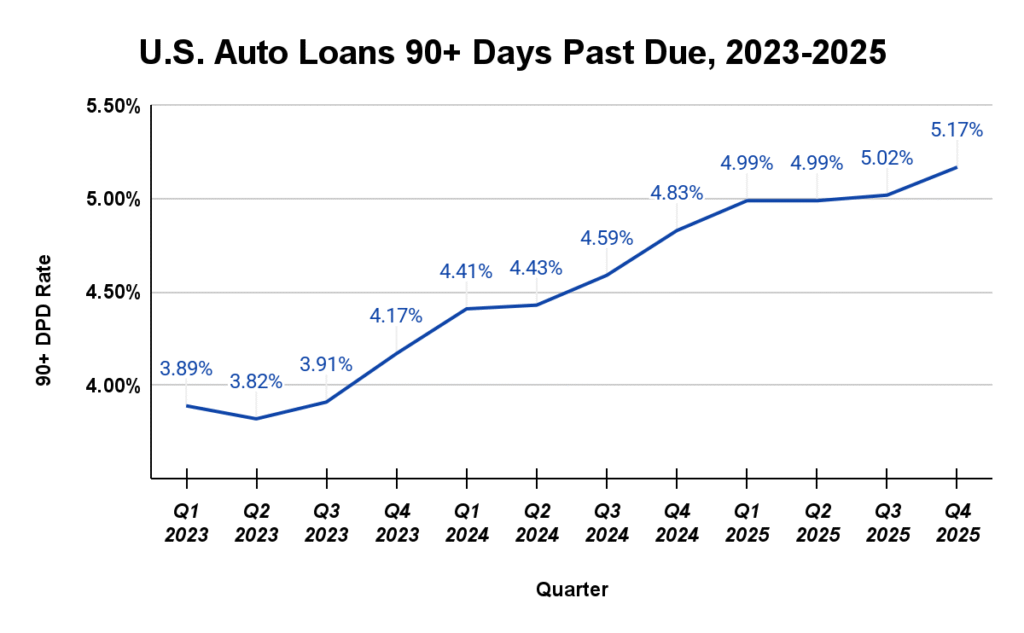
This trend matters because loans that reach the 90+ day stage rarely self-correct. At this point in the lifecycle, the odds of a borrower curing the account drop sharply, while the likelihood of repossession and eventual charge-off rises.
Even small percentage shifts at this level are operationally significant. For a large lender with hundreds of thousands of accounts, a move from 4% to over 5% delinquency can represent thousands of additional problem loans flowing into late-stage collections.
What’s Driving the Increase in Defaults
Several measurable trends have made auto financing more expensive and riskier for many borrowers:
- Higher vehicle prices and larger loan balances: The average new vehicle price climbed from about $48,000 in Q4 2024 to over $50,000 in Q4 2025, pushing financed amounts higher.
That increase shows up directly in monthly payments. Typical new-car payments rose from roughly $700–$720 in 2024 to about $772 in 2025, while used car payments averaged $532. Higher required payments leave borrowers less room for error, especially in near-prime and subprime tiers, fueling more late payments and defaults. - Credit mix and term extension trends: Auto finance has seen a meaningful share of originations to near-prime and subprime borrowers in recent years. These groups, by definition, are more sensitive to affordability pressures and higher financing costs, and they are disproportionately represented among accounts moving into the 90+ DPD category.
At the same time, many borrowers are taking out longer-term loans (72–84+ months) to make higher vehicle prices more affordable, which can stretch monthly obligations over a longer period and delay equity building. This pattern increases vulnerability to payment disruptions. - Normalization after stimulus and underwriting shifts: During 2020–2022, government stimulus and pandemic-era underwriting practices suppressed early delinquencies, making performance look artificially strong.
As stimulus effects faded and underwriting practices shifted back toward more normal conditions, existing loans began to season into higher delinquency levels. This normalization is a key reason why serious delinquency has trended higher even as broader employment and economic indicators remained stable.
Together, these dynamics help explain why auto portfolios are experiencing steadily rising 90+ DPD rates and, by extension, a higher default risk.
Auto Loan Default Rates: 2026 Predictions
Auto loan default rates are unlikely to reverse quickly. Most signs point to continued but stable pressure, not another sharp jump.
Key expectations:
- Default rates remain elevated: Serious delinquency (90+ DPD) is expected to hover near 2025 levels rather than spike higher because most of the payment shock has already flowed through portfolios. Loans originated during the peak price and rate environment of 2022–2024 are already seasoning into late-stage delinquency. Unless macro conditions worsen dramatically, the next phase is stabilization, not acceleration.
- Subprime drives most of the risk: Higher-credit tiers should remain relatively stable, while subprime and near-prime segments continue to account for the majority of defaults and repossessions, as those borrowers have the highest payment-to-income ratios and the lowest equity cushions. When budgets tighten, these accounts are typically the first to reach distress thresholds.
- Affordability stays tight: High vehicle prices and monthly payments mean many borrowers will remain vulnerable to income disruptions because loan balances have risen faster than wages in many markets. Even small shocks, like overtime reductions or rising insurance costs, can push already-stretched borrowers into delinquency.
- Operational execution becomes the differentiator: Early-stage collections, workout strategies, and remarketing efficiency will have an outsized impact on outcomes because lenders can no longer rely on portfolio growth alone to offset losses. In a high-balance environment, small improvements in cure rates, recovery timing, or resale pricing can materially affect portfolio performance.
Overall, 2026 is shaping up as a disciplined risk-management year. Lenders that focus on structure, segmentation, and collections performance will navigate defaults far more effectively than those relying on broad portfolio averages.
U.S. Auto Repossession Trends
Repossession volumes are the most tangible outcome of rising delinquency. While delinquency rates show potential stress, repossessions show what actually turned into loss events.
Latest Auto Repossessions Data
Repossession volumes accelerated in 2025 as the backlog of serious delinquencies finally converted into recoveries.
What the numbers show:
- By Q4 2025, more than 2.2 million vehicles had already been repossessed in the U.S.
- Industry projections point to 2025 year-end totals exceeding 3 million repossessions, a level not seen since the aftermath of the Great Recession.
The Reason Behind The Repossession Surge
From 2020 to 2022, repossession activity collapsed to historic lows. Stimulus payments, loan forbearance programs, and unusually tight underwriting kept borrowers afloat. Lenders recovered far fewer vehicles than normal.
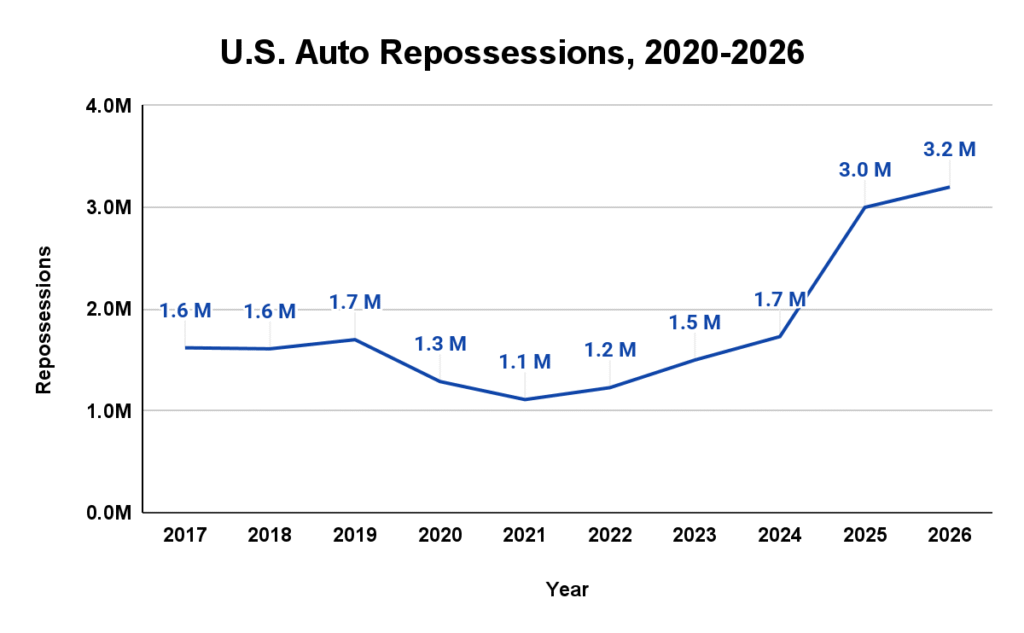
Then, 2023–2024 saw the normalization phase. As the stimulus faded and the monthly payments climbed, serious delinquencies began converting into recoveries again. Repossessions rose sharply year over year as lenders worked through a backlog of troubled loans that had been artificially supported in prior years.
By 2024, the industry had largely returned to “normal” pre-pandemic recovery patterns, but with one important difference: loan balances were much larger than they used to be.
In 2025, repossessions moved higher again. Not because underwriting suddenly got reckless, but because loans originated in 2022–2024 carried higher vehicle prices, higher interest rates, longer terms, and thinner borrower equity.
As those loans aged, more of them reached 90+ days past due and ultimately rolled into recovery.
Repossession Rates: 2026 Predictions
Most analysts expect 2026 to look more like a continuation of 2025 than a dramatic jump. The big surge already happened between 2023 and 2025. The next phase is likely to be high but stable volumes.
That being said, there are some areas for concern. The loans most at risk in 2026 are:
- used-vehicle loans with high LTVs
- longer-term contracts originated in 2023–2024
- near-prime and subprime borrowers facing tighter budgets
Lenders spent 2025 tightening credit standards. Those actions should gradually slow the pace of new problem loans entering the system, which may prevent repossessions from accelerating sharply beyond current levels.
Auto Loan Collection Trends
Here’s what the most recent data tells us about collections performance:
- Recovery outcomes are getting harder: According to Recovery Database Network (RDN) data, the auto recovery ratio improved to 30.58% in Q3 2025, meaning lenders recovered roughly 30 cents for every dollar of outstanding balance entering the repossession pipeline. That represents progress compared with earlier quarters of the year.
- Higher balances are amplifying losses: Average charge-off amounts per defaulted auto loan increased again in 2025, as larger financed amounts and longer terms left borrowers with less equity at the time of repossession.
- Collections timelines are extending: Many lenders report longer resolution cycles as borrowers struggle to cure late payments, pushing more accounts from 30–60 days past due into 90+ DPD and eventual recovery workflows.
As more accounts require manual intervention, staffing and collections expenses also rose year over year across many auto portfolios.
Auto Collections: 2026 Predictions
Most forecasts expect collections pressure to remain elevated through 2026. Even if delinquency growth moderates, portfolios originated in 2023–2025 carry larger balances and thinner equity cushions, suggesting recoveries are likely to remain below pre-pandemic averages.
What Successful Lenders Will Do Differently in 2026
The lenders that navigate this environment best will be those that treat these trends as operational signals.
Practical priorities for 2026 include:
- Segmenting portfolios by credit tier and vintage instead of relying on broad averages
- Tightening deal structures for higher-risk segments
- Investing in earlier-stage collections outreach
- Using data to identify regional and channel-specific risk
- Automating workflows to handle higher delinquency volumes efficiently
- Improving recovery processes to close the gap with historical performance
Auto loan default rates, repossession, and collections statistics are strategic inputs that should shape underwriting, pricing, and servicing decisions.
Turn Data Into Action with defi SOLUTIONS
Managing rising delinquencies and the complexity of collections is a notably difficult challenge for lenders of all sizes. Between rising late-stage account volume, pressure on servicing capacity, and the need for faster, data-driven decisions, even seasoned professionals often need the help of modern infrastructure to stay competitive.
Whether you’re looking to strengthen internal operations or explore outsourced servicing, defi SOLUTIONS provides the technology and expertise to help lenders manage auto loan default rates to improve borrower outcomes.
Book a demo with defi to learn how our platform and managed services support smarter, more resilient auto lending.


