

Loan origination is a volume business with thin margins per transaction. The lenders who consistently outperform on profitability are running operations where fewer deals fall out, less manual effort is required for work the system could handle, and fewer fraud losses reach the portfolio. Loan origination automation technology is what makes that operational profile achievable at scale.
This article covers how the right lending automation technology improves auto lender profitability across the areas that matter most.
Financial Impact of Loan Origination Automation Technology
The table below summarizes where automation has the most direct financial impact.
| Performance Area | Operational Improvement | Typical Impact Range | Revenue/Cost Effect |
| Decision Speed | Policy-based automation | +2%–5% capture improvement | More funded loans and direct revenue growth |
| Underwriter Productivity | Exception-based routing | 25%–50% more files per full-time employee (FTE) | Lower labor cost per funded loan |
| Funding Cycle | Integrated docs + e-sign | 1–3 day reduction | Faster revenue recognition and less deal fallout |
| Fraud Filtering | Real-time validation at submission | 10%-20% reduction in fraud/early payment default (EPD) losses | Protects portfolio yield and reduces avoidable losses |
| Cost Per Loan | Reduced manual touchpoints | 10%–25% reduction in origination cost | Improves margin as funded volume scales |
The specific impact varies by institution, loan volume, and the degree of automation implemented. The pattern is consistent: automation improves revenue capture, protects portfolio yield, and slows the growth of operating expense relative to funded volume.
How Loan Origination Automation Technology Increases Revenue
Revenue growth in auto lending depends on how efficiently applications convert into funded loans. Loan origination automation technology influences the conversion rate in four measurable ways:
1. Faster Decisions Improve Capture Rates
In indirect lending, speed directly affects capture. While results vary by dealer network, credit strategy, and program structure, many lenders operate within a broad capture range, typically 20% to 40% of submitted applications. When decisioning improves from hours to minutes for routine, policy-fit deals, lenders can see capture increase by 2 to 5 percentage points. In competitive dealer environments where a faster lender is always an option, response time is often what determines placement.
Loan origination automation technology addresses this by embedding policy-based decisioning directly into the workflow.
- Routine, in-policy applications are evaluated as soon as they enter the system.
- Exceptions are routed automatically to the appropriate reviewer, with relevant risk flags already identified, so files don’t sit in a queue waiting for someone to open them.
To quantify the impact of decision speed on conversion, the chart below illustrates how fast decisioning improves capture rates across typical lending scenarios.
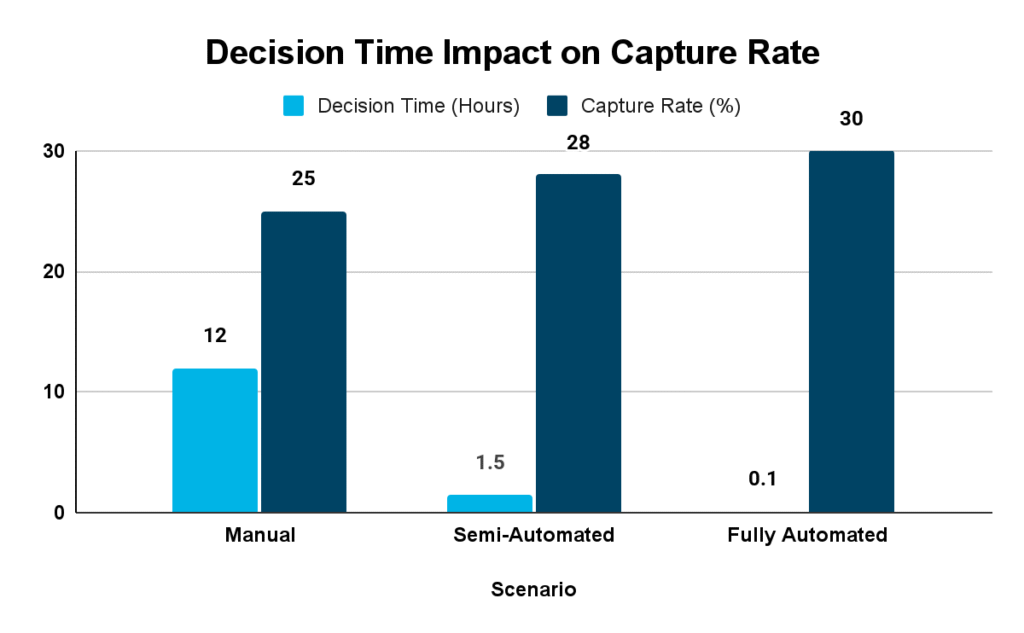
*Decision times reflect representative averages based on typical manual and automated lending workflows. Actual timing varies by lender systems, team size, and process design.
As decision times compress from hours to minutes, capture rates increase meaningfully. Even a 2–5 percentage point improvement translates directly into more funded loans and incremental revenue, particularly in competitive dealer environments where speed determines placement.
Ultimately, the practical effect of faster decisioning shows up across three areas:
- Same-day approval volume. Applications that enter the system during business hours can be decisioned and returned before the dealer’s day ends.
- After-hours and weekend capture. Dealers who submit late in the day or over the weekend receive responses without waiting until the next business day.
- Dealer relationship quality. Lenders who respond predictably and consistently become the path of least resistance. That reliability compounds over time into stronger submission volume.
For lenders competing on indirect volume, the ability to decision applications faster than the competition is the difference between being a lender that dealers rely on and one that they submit to when their preferred options are slow.
2. Shorter Funding Cycles Accelerate Revenue Recognition
Every day between a signed approval and a booked loan is a day that revenue hasn’t been recognized, and the deal can still fall apart. For many lenders, funding cycles typically range from 3 to 7 days, depending on documentation workflows and dealer coordination. With more automated processes, that window can often be reduced to 1 to 3 days, particularly for standard, well-structured deals.
| Typical Funding Timeline Comparison | ||
| Stage | Manual Process | Automated Process |
| Approval to docs | 1–2 days | Same day |
| Stipulation clearing | 1–3 days | Same day–1 day |
| Signing & return | 1–2 days | Same day |
| Total funding cycle | 3–7 days | 1–3 days |
Manual documentation processes are where that window gets longest. Missing stipulations, unsigned forms, and back-and-forth between lenders and dealers extend the time between approval and a funded deal. Loan origination automation technology shortens that window by removing the manual handoffs that cause it.
- Automated document generation prepares contract packages immediately after approval using information already captured in the application.
- Stipulation tracking ensures outstanding items are identified, requested, and monitored within the platform rather than managed through email threads.
- eContracting and eSignature workflows eliminate paper and in-person steps, allowing loans to be sold, assigned, and transferred in days rather than weeks.
The practical impact shows up in three areas:
- Faster revenue recognition. Loans that fund sooner book sooner, accelerating the timeline on which interest income is realized.
- Higher approval-to-funding conversion. Shorter documentation windows give borrowers and dealers less time to reconsider or find an alternative lender.
- Reduced deal fallout. Most deals that die after approval die during documentation. Tighter workflows mean fewer opportunities for that to happen.
For lenders processing high volumes, reducing average funding time by even 1 to 2 days can meaningfully shift revenue timing and improve overall portfolio performance.
3. Expanded Throughput Without Linear Hiring
When every file requires manual review, more applications mean more underwriters are needed. Loan origination automation technology breaks that relationship.
- Once decision rules are embedded in the workflow, applications that meet policy criteria can be approved automatically without underwriter involvement.
- Only true exceptions, files with risk signals, incomplete data, or policy edge cases, reach a human reviewer.
- The underwriting team’s time goes toward decisions that actually require judgment rather than being consumed by files that the system could clear in seconds.
The result is a different capacity curve. The same team can process more volume meaningfully during peak periods, whether that’s a seasonal spike in dealer submissions or a broader market uptick, without hiring to match it. Fixed personnel costs grow more slowly than funded loan volume.
- Peak capacity without temporary hiring. Automated decisioning absorbs volume spikes without creating backlogs or requiring short-term headcount additions.
- Underwriting focused on exceptions. Reviewers spend their time on the files that need them, which improves both decision quality and throughput per person.
- More favorable cost per loan. As automated volume grows, the fixed underwriting costs are spread across a larger number of funded loans.
The chart below illustrates how the cost per loan declines as automation increases.
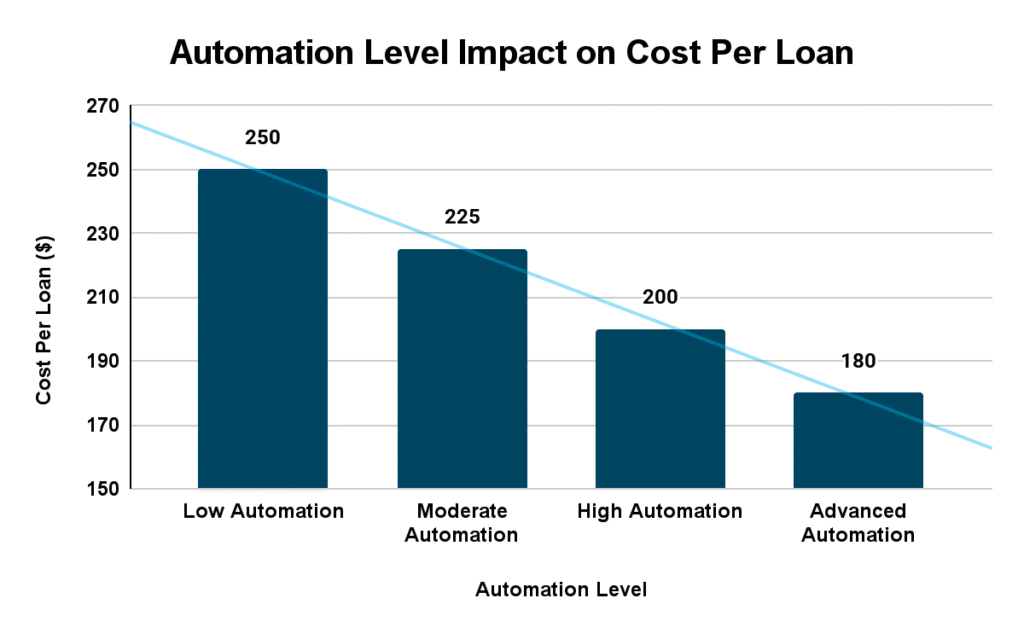
*Cost estimates are illustrative and reflect typical reductions in manual effort and processing overhead as automation increases. Actual results vary by lender operations, volume, and workflow design.
Reducing manual touchpoints lowers labor, rework, and processing overhead. As automation scales, fixed costs are spread across more funded loans, improving margin and allowing lenders to grow volume without proportional cost increases.
4. Cleaner Risk Filtering Protects Yield
A portfolio with strong origination numbers isn’t performing well if it has elevated early payment defaults and fraud-related losses.
Loan origination automation technology moves risk filtering to the front of the process.
- Integrated fraud detection, income validation, and collateral verification run at submission, before a credit decision is made.
- Deals with misrepresented income, inflated collateral values, or identity irregularities get flagged before they become funded loans.
That front-loaded filtering shows up across three areas of portfolio performance:
- Lower early payment default rates. Deals that clear automated verification at intake are less likely to deteriorate quickly after booking.
- Reduced fraud-related charge-offs. Catching misrepresentation at submission removes losses that manual review, applied later in the process, tends to miss.
- More stable net yield. A cleaner book produces more predictable return performance over time, which matters as much to portfolio management as top-line volume.
Over time, better risk filtering strengthens portfolio return rather than simply expanding origination volume.
Improve Your Bottom Line with Loan Origination Automation Technology
In auto lending, small operational improvements compound quickly.
- Faster decisions capture more dealer business.
- Shorter funding cycles reduce deal fallout.
- Cleaner risk filtering protects portfolio performance.
- Automation allows lenders to scale volume without expanding headcount at the same pace.
Loan origination automation technology brings these capabilities together by turning manual, disconnected steps into a coordinated workflow. Platforms such as defi SOLUTIONS help lenders implement automated decisioning, integrated documentation, and real-time validation to improve origination efficiency and portfolio outcomes.
Book a demo with the defi team to see how these capabilities work in practice.


